This page shows pricing in GBP (£). If you'd prefer to pay in USD ($), switch your currency above.
Individual Mini-Course Series
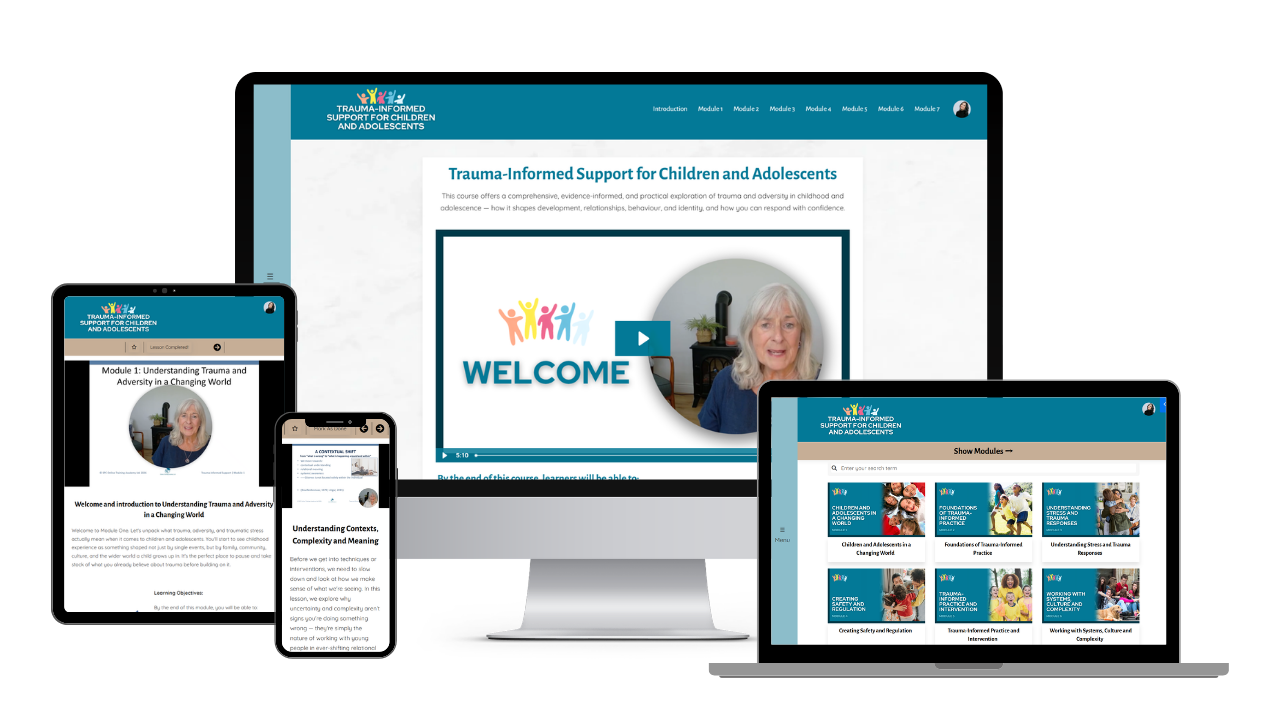
Trauma-Informed Support for Children and Adolescents in a Changing World
Choose Your Path
MODULE 1
Children and Adolescents in a Changing World
What you'll learn:
- How to make sense of complexity and uncertainty in practice, rather than treating them as signs you're doing something wrong
- The global and contextual drivers of distress in children and adolescents — digital environments, economic insecurity, and more
- How to apply an adapted ACE framework without reducing a child to a score
MODULE 2
Foundations of Trauma-Informed Practice
What you'll learn:
- How to distinguish acute, chronic, developmental, and complex trauma
- The six core principles of trauma-informed practice — safety, trust, choice, collaboration, empowerment, and cultural humility
- Practical micro-skills — tone, pacing, silence — that build safety without doing more
MODULE 3
Attachment, Relationships, and Emotional Safety
What you'll learn:
- How to differentiate externalising and internalising presentations — and why quiet doesn't mean fine
- How anxiety hides behind school refusal, irritability, and perfectionism
- How to spot shared patterns beneath very different behaviors, using contrasting case studies
MODULE 4
Recognising Trauma Responses and Behaviour
What you'll learn:
- The difference between physical safety and felt safety — and why only one of them regulates the nervous system
- How to co-regulate using tone, pacing, and emotional containment
- Grounding and breathing techniques matched to a young person's nervous system state
MODULE 5
Trauma-Informed Practice and Intervention
What you'll learn:
- How to deliver psychoeducation as a two-way conversation, using accessible metaphors
- Narrative techniques that help young people reshape what their story means about who they are
- How to reframe coping — even "maladaptive" coping — as a meaningful attempt to manage stress
MODULE 6
Working with Systems, Culture and Complexity
What you'll learn:
- How to apply trauma-informed principles to caregivers — shifting them from "the problem" to partners in the work
- The shift from cultural competence to cultural humility, and why it matters
- How to move from seeking control to practicing responsiveness within complex, non-linear systems
MODULE 7
Integration and Use of Self
What you'll learn:
- How to distinguish countertransference, vicarious trauma, and secondary traumatic stress — and respond to each appropriately
- The ProQOL model for understanding compassion satisfaction, burnout, and secondary traumatic stress
- How to build a personal approach that grows through reflection, supervision, and experience — not a fixed formula
